


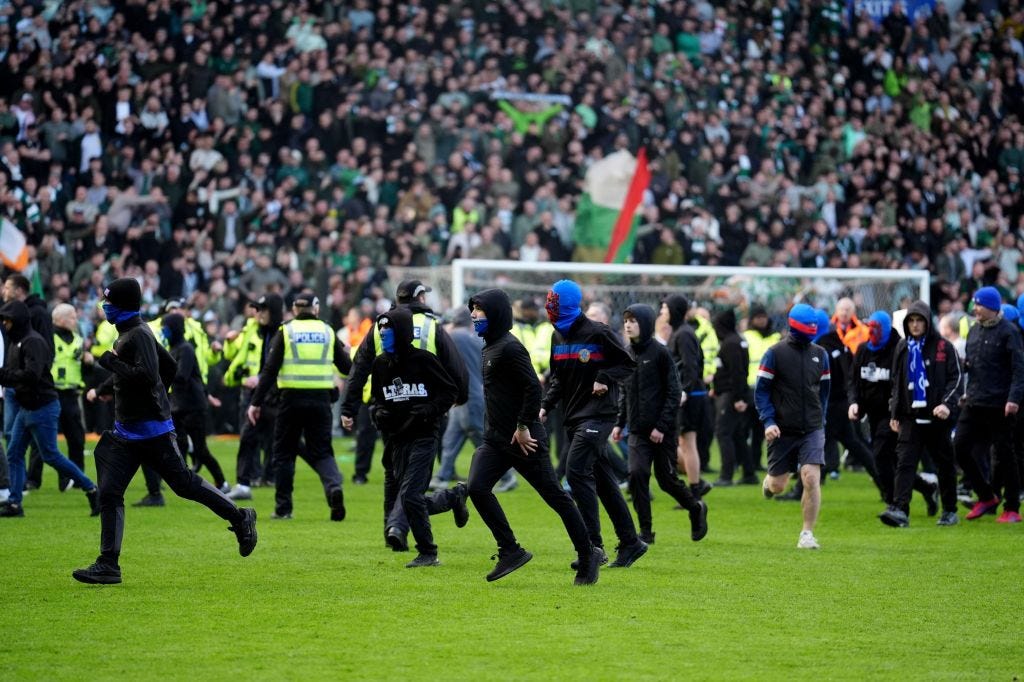
Celtic and Rangers have lodged appeals against a Scottish FA ruling that would require each club to play its next home Scottish Cup tie behind closed doors after violence and disorder overshadowed last season’s quarter-final tie between the two sides at Ibrox.
The clubs are also challenging an order to pay £100,000 to the opposition for the affected fixture. Under the terms of the disciplinary ruling, any further disorder at a Scottish Cup match before the end of next season could trigger a second home tie without supporters. An appeal hearing is scheduled for 26 October.
The sanctions stem from Celtic’s Scottish Cup quarter-final win at Ibrox in March, when supporters of both clubs entered the playing area after a goalless draw was settled by a penalty shoot-out. Celtic won 4-2 on penalties, with visiting fans spilling on to the pitch to celebrate after the decisive kick before Rangers supporters invaded the pitch to attack them.
Fireworks were thrown, missiles were launched, stewards, and police officers were injured during the disorder. Celtic staff were also attacked. Police Scotland has made 43 arrests in connection with the incident.
The fixture was the first Glasgow derby at Ibrox since 2018 in which Celtic had received the full Broomloan Stand allocation, allowing approximately 7,500 visiting supporters to attend. The allocation was made in line with Scottish Cup requirements.
A week earlier, the sides met in the league with Celtic given around 2,500 tickets, reflecting an agreement to allocate roughly 5% of capacity to away supporters. That arrangement had followed several seasons in which allocations were sharply reduced or, at times, away fans were excluded altogether.
Celtic described the Scottish FA’s punishment as “shocked” and “disproportionate”. Rangers subsequently offered Celtic only 300 tickets for their League Cup meeting at Ibrox this month, saying its decision reflected the findings of an independent review commissioned after the Scottish Cup tie.
Rangers also referred to further pitch incursions involving Celtic supporters since March. Celtic rejected the proposed allocation, prompting intervention from the SPFL. The outcome was a ban on away supporters at league and League Cup meetings between the two sides for the remainder of the season.
Review warns of near miss
An independent report, led by Mark Blackbourne, concluded that the events at Ibrox came close to producing crushing and potentially life-threatening violence.
The report said Celtic supporters had initially entered the pitch in celebration, while supporters associated with the Rangers’ Union Bears group moved on to the track and towards the playing surface in a manner it described as confrontational and threatening.
Blackbourne wrote: “The Celtic Ultras were the first to enter the pitch in jubilation, with others following their lead.
“In contrast, the Union Bears’ movement onto the track and towards the pitch was reactionary, confrontational, and overtly threatening. In both cases, the proximity of these groups to the playing surface materially increased the likelihood of a mass incursion and contributed to the rapid escalation of disorder.”
The report condemned the actions of the several hundred Celtic supporters who entered the pitch, saying the incursion provoked an immediate response from sections of the Rangers support who forced their way past stewards and police in an attempt to reach the Celtic fans.
It also highlighted concerns expressed at a Glasgow City Council safety advisory group meeting, where experienced Police Scotland officers were reportedly described as “petrified” at the prospect of policing another match at Ibrox.
Blackbourne said the language should be understood in context but remained “deeply disturbing”, adding that it demanded serious attention from all parties responsible for safety and security at major matches in Scotland.
The review also said some interviewees had identified organisational features among certain ultra groups that they believed resembled those more commonly associated with organised crime. It called on clubs to impose tougher internal sanctions for incidents linked to such groups.