


Scotland’s recent international record is a study in contrast. Under Steve Clarke, the national side ended a long absence from major tournaments, reached two European Championships in succession and returned to the World Cup for the first time since 1998. Yet our tournament record remains abysmal with no group-stage win at either Euro 2020 or Euro 2024, and no progression beyond the opening round at either finals. The 2026 World Cup brought one win, against Haiti, but defeats to Morocco and Brazil left Scotland out on goal difference.
That makes the best nights of this period more complicated than a simple success story. Scotland have often been at their most convincing before the tournament begins - on qualifying nights, under pressure, when the stakes are clear and the opponent can be confronted rather than cautiously managed. The five games below are matches that explain why the Tartan Army continue to believe that Scotland can compete on the biggest stage.
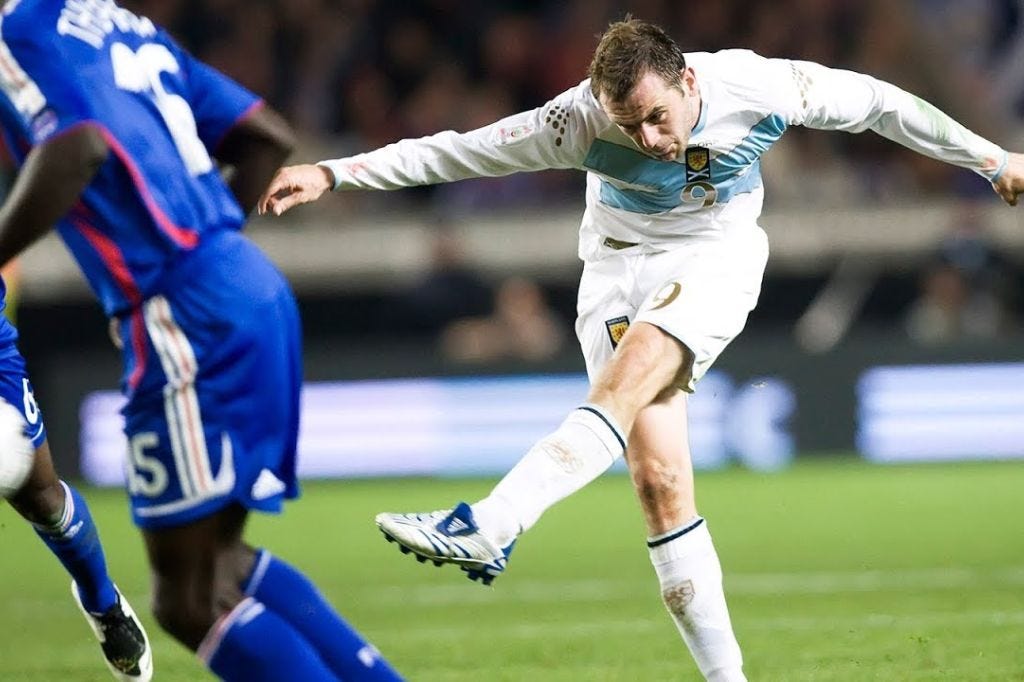
France 0–1 Scotland - 12 September 2007
The modern benchmark remains Paris. France had reached the World Cup final 14 months earlier and had already been beaten by Scotland at Hampden in the opening stages of Euro 2008 qualifying. That first result was startling; the return in Paris looked close to impossible. France were at home, wounded by the Hampden defeat and equipped with the sort of depth Scotland could not match.
Scotland went there needing something. A defeat would have left their qualification prospects exposed, while a draw would have been an achievement in itself. Instead, they won, and they did so in the manner that gave the result its lasting status - disciplined for most of the evening, ruthless at precisely the right moment.
Alex McLeish’s team did not attempt to dominate possession or trade attacks with France. Scotland’s shape was compact, the midfield worked without pause and the defence limited the space available to a side accustomed to finding it. The visitors made the match awkward, then increasingly uncomfortable.
James McFadden’s goal in the 64th minute shifted it into folklore. Receiving the ball deep inside the French half, he looked up, saw Mickaël Landreau away from his line and struck from a distance that stunned everyone. The shot rose and dipped beyond the goalkeeper and into the net. It was a finish that appeared reckless until the moment it became perfect.
Scotland had time to lose control after that. They did not. They defended with a calm that made the result feel earned rather than stolen, completing a double over the World Cup runners-up and taking their Euro 2008 campaign to a level few had imagined possible.
They did not qualify in the end. The defeat by Italy at Hampden remains the obvious wound from that campaign. But Paris has outlived the disappointment because it captures a version of Scotland that was entirely convincing - clear in its plan, strong in its nerve and willing to produce a decisive act of quality when the chance arrived.
Scotland 4–2 Denmark - 18 November 2025
The win over Denmark was the most dramatic Scottish result of the Clarke era and the clearest expression of how far the national side had travelled in terms of expectation. Scotland were no longer trying to keep a campaign alive. They were playing for first place in a World Cup qualifying group and automatic passage to the finals.
A draw or defeat would have sent Denmark through as group winners and Scotland into the uncertainty of the play-offs. The practical task was simple enough win at Hampden. The reality was more difficult. Denmark had the technical quality to punish hesitant pressing and enough experience to understand how to manage an occasion that was threatening to overwhelm the home side.
Scott McTominay removed some of that tension early. His stunning overhead kick was not merely a fine goal; it altered the terms of the match. Hampden had arrived anxious, conscious of the years since France 1998 and wary of Scotland’s habit of making qualification hard work. The goal brought immediate belief.
Denmark responded twice and Scotland had to endure the unsettling prospect that a memorable evening might become another case of failure at the final obstacle. At 2–2, with stoppage time underway, the visitors were on course to take the place Scotland wanted.
Kieran Tierney changed that. His injury-hit international career had left the sense that Scotland had not seen enough of him in matches of real consequence. His stoppage-time finish delivered the goal that took Scotland to the edge of qualification. Kenny McLean then turned relief into absurdity, striking from inside his own half after spotting Danish goalkeeper Kasper Schmeichel out of position and scrambling back.
The ball’s long journey towards goal gave the whole of Scotland time to understand what it was witnessing. When it crossed the line, the match was settled and the result was secured. Scotland had beaten Denmark 4–2 and qualified for the World Cup for the first time in 28 years. All of Scotland celebrated.
It was a magnificent qualification night, though its place in the wider Clarke record is also instructive. Scotland had earned a return to the World Cup; they then had to show that they belonged. They did not, despite defeating Haiti in the finals. Losses to Morocco and Brazil meant another early exit, this time on goal difference and that ultimately ended the Steve Clarke era.
Scotland 2–0 Spain - 28 March 2023
Scotland’s victory over Spain at Hampden was probably the most complete performance in this list. It was not dependent on a late swing, a single counterattack or an opponent failing to take chances. Steve Clarke’s side knew exactly how they wanted the game to unfold and carried out the plan with a level of precision that Spain could not answer.
Spain had changed from the team that dominated international football between 2008 and 2012, but they retained the habits and technical standards associated with that era. They expected possession and had enough talented players to turn long spells on the ball into pressure. Scotland allowed them possession but denied them authority.
The home side pressed aggressively in the right areas, closed the central spaces and ensured that Spain’s passing became increasingly sterile. Scotland did not simply retreat and wait. They attacked the weak points when they appeared and made their own moments count.
McTominay opened the scoring after Spain failed to deal with a ball into the area. The second was more emphatic, a strike that gave Scotland a two-goal lead and put the visitors in a position they had not expected to occupy.
The performance mattered because it established the tone of the Euro 2024 qualifying campaign. Scotland had already beaten Cyprus, but Spain was the result that made the group feel open. It was their first competitive win over Spain and it suggested that qualification could be achieved through more than survival and calculation.
Scotland duly qualified for Euro 2024 with two matches to spare. But the contrast with the finals was sharp. They lost heavily to Germany, drew with Switzerland and then lost to Hungary, exiting at the group stage without a win. The Spain performance showed Scotland at their best - compact, forceful and decisive. In Germany, they struggled to reproduce it when the games themselves became the destination rather than the route towards one.
Scotland 1–0 France - 7 October 2006
The victory in Paris is the greater headline, but the Hampden win over France gave Scotland’s Euro 2008 campaign its direction.
Walter Smith’s side were still finding their feet. France had reached the World Cup final during the summer and arrived in Glasgow with a squad full of players accustomed to Champions League football and the demands of major tournaments. Scotland had little interest in meeting them on equal terms stylistically. They set about reducing the game to its essential contests and winning enough of them.
The match was built on defensive discipline. Scotland were compact, physically committed and economical in possession. France had more of the ball, but they struggled to convert that superiority into clean chances. The home team had made the pitch feel crowded and the game feel uncertain.
Gary Caldwell’s goal early in the second half gave Scotland something tangible to protect. He scored from a set-piece situation, and the task changed immediately. France had to chase the game; Scotland had to prove that the lead was not beyond them.
What followed was an extended exercise in nerve. France pressed, but Scotland did not collapse into panic. The back line cleared danger, the midfield covered ground and Hampden responded to every intervention as though it might decide the campaign. The final whistle brought a win that was less glamorous than the one to come in Paris, but arguably more important in shaping what followed.
Scotland had beaten one of Europe’s strongest teams not through luck but through a coherent game plan. Smith understood the limits of the squad available to him and built an approach around collective work, set pieces and defensive clarity. The result gave Scotland a platform. It also gave France a reason to take the return fixture seriously, which made McFadden’s intervention in Paris all the more remarkable.
Norway 1–2 Scotland - 17 June 2023
The Norway game is the most important away result of the Clarke era. It was also the match that confirmed Scotland could win in more than one way.
Norway were Scotland’s most obvious competitors for qualification from the Euro 2024 group. They had Erling Haaland, home advantage and the prospect of pulling Scotland back into a contest that had begun well for Clarke’s side. A draw would have been acceptable. A defeat would have changed the dynamics of the campaign.
For most of the match, defeat seemed likely. Haaland scored from the penalty spot and Scotland, though committed and organised, had not created enough to suggest a late recovery. The match was entering its closing stages with Norway protecting a lead and the visitors facing a damaging setback.
Then Scotland found two goals in a matter of minutes. Lyndon Dykes levelled after Norway made a defensive error, reacting quickly to take the chance Scotland had been waiting for. It would have been understandable for the visitors to settle for the point. Instead, they attacked again. Kenny McLean scored the winner, and the away end was left trying to process a turnaround that had seemed impossible moments earlier.
The value of the result was immediate. Scotland moved six points clear of Norway and gained the margin that later allowed them to absorb setbacks without losing control of the group. The emotional value was larger still. Scotland had too often been associated with commendable defeats and missed chances. Oslo offered something more useful - an opponent wobbling, a door opening and Scotland walking through it.
Honourable mention: Scotland 2–2 England - 10 June 2017
It does not make the five because Scotland did not win, and Harry Kane’s stoppage-time equaliser turned what should have been a famous victory into a draw that felt like a defeat - if only Stuart Armstrong didn’t play that pass! But few modern Scotland matches have generated such a sudden, sustained sense of bedlam. Alex Oxlade-Chamberlain’s goal appeared to have put England in control before Leigh Griffiths scored two outstanding free-kicks in three minutes, the second arriving in the 90th minute to send Hampden into delirium. For a brief period, Scotland were on course for a first win over England since 1999; Kane’s late finish denied them, but Griffiths’s double remains one of the defining individual moments at Hampden in the modern era.
Scotland have proven they can qualify for major tournaments. They have yet to prove that they can compete effectively once they are there. The five matches in this list remain outstanding because each showed a team willing to play without fear when qualification was on the line. The unresolved challenge is why that same freedom, aggression and conviction have not travelled with them into the finals.