


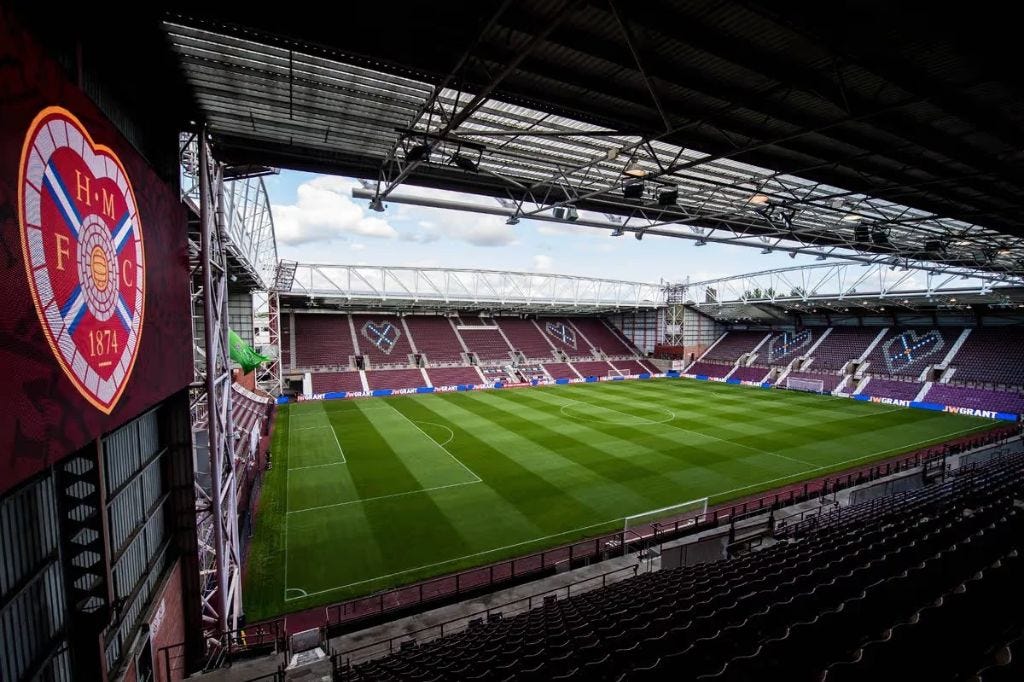
Heart of Midlothian’s latest financial report is best read as a club trying to buy its way back into relevance without quite admitting how expensive that habit has become. The headline is genuinely encouraging - record turnover for a season without European football, commercial growth and a squad strong enough to take the Premiership title race to the final day. The fine print, however, reveals a £7.3m annual loss, rapidly falling cash and a business still heavily dependent on the generosity of supporters and benefactors.
Let’s start with the good, because there is plenty of it. Hearts generated £23.1m in turnover despite no European income, with sponsorship and advertising up 37% to £2.2m and retail and hospitality up 17%. Gate receipts remained robust at £5.6m, while commercial income rose to £8.6m, clear evidence that Tynecastle is becoming more than a football stadium.
The club also invested with intent. Player-registration additions totalled £7.8m, helping build a squad that finished second in the Premiership and secured Champions League qualifying football for the first time in 20 years. Player trading produced £1.8m of gains, up from £1.3m the previous year, and the balance sheet still shows net assets of £20.3m.
There is also a broader institutional health here. Foundation of Hearts contributed £1.49m during the year, taking its cumulative support beyond £20m, while the club’s hotel, events and retail operations are no longer peripheral vanity projects but meaningful revenue engines.
Now the part the club’s summary handles with a lighter touch. The much-publicised £2.4m operating loss is an EBITDA-style measure - it excludes depreciation, amortisation, finance costs and includes £1.8m of player-trading profit. The bottom line is far less flattering. After £4.8m of depreciation, amortisation and write-downs, plus £449,000 of interest, Hearts recorded a loss for the year of £7.3m.
That is not necessarily fatal in football, where investment is often front-loaded. But the cash position is less comfortable. Cash fell from £10.3m to £4.9m, a decrease of £5.4m in a single year. Operating activities absorbed £3.5m, while the club spent £4.5m on player registrations and received only £2.3m from sales.
The club also moved from net current assets of £1.25m to net current liabilities of £8.3m. Short-term creditors rose from £13.8m to £19.7m, while debtors increased sharply to £5.5m. None of that is automatically a crisis, but it means Hearts have less immediate financial slack than the headline net-assets figure suggests.
The ugliest number is not the loss; it is the structural reliance that sits behind it. Donations totalled just under £6m, including £4.5m from benefactors and £1.49m from Foundation of Hearts. The auditors’ going-concern assessment explicitly identifies continued support from fans, sponsors, the Foundation and the club’s principal benefactor as key inputs to the cash-flow forecasts.
Fan ownership and benevolent capital have rescued Hearts before. But it does mean the club’s financial model remains unusually exposed to private goodwill. If a major benefactor’s enthusiasm cools, or if the Foundation’s pledger base plateaus, the margin for error narrows quickly.
Tony Bloom’s involvement adds another layer of complexity. The club drew down a further £1m on a director loan during the year, taking the amortised cost of that borrowing to £5.99m. No capital or interest repayments were made during the period. The accounts also record a £243,000 exceptional gain because the below-market loan was recognised at fair value – an accounting benefit, not money in the till.
Meanwhile, the club has £15.8m of accumulated tax losses it cannot yet recognise as a deferred tax asset, because it is not clear that sufficient taxable profits will arise in the foreseeable future. That is a blunt accounting way of saying that Hearts have been losing money for some time.
What it means though is that Hearts are not in the perilous territory of a club living beyond its means with no assets, no income growth and no plan. Quite the opposite in fact - revenue is growing, the stadium is working harder, the academy and women’s team are delivering, and European football should restore a substantial income stream in 2026-27.
But this is a gamble dressed up as prudence. The club spent heavily without European revenue, accepted a £7.3m loss, watched cash halve, and now needs player sales, UEFA income and continued benefactor support to make the model add up. The report itself concedes that much of the financial return from last season’s investment falls into the current financial year.
For supporters, the message should be neither panic nor complacency. Hearts have built a stronger commercial base and made a rational bet on sporting success. The risk is that “measured ambition” becomes a euphemism for recurring losses underwritten by a small number of very generous people. The next set of accounts must show that European football, player trading and commercial growth can convert promise into sustainable profit – rather than merely postponing the reckoning.