


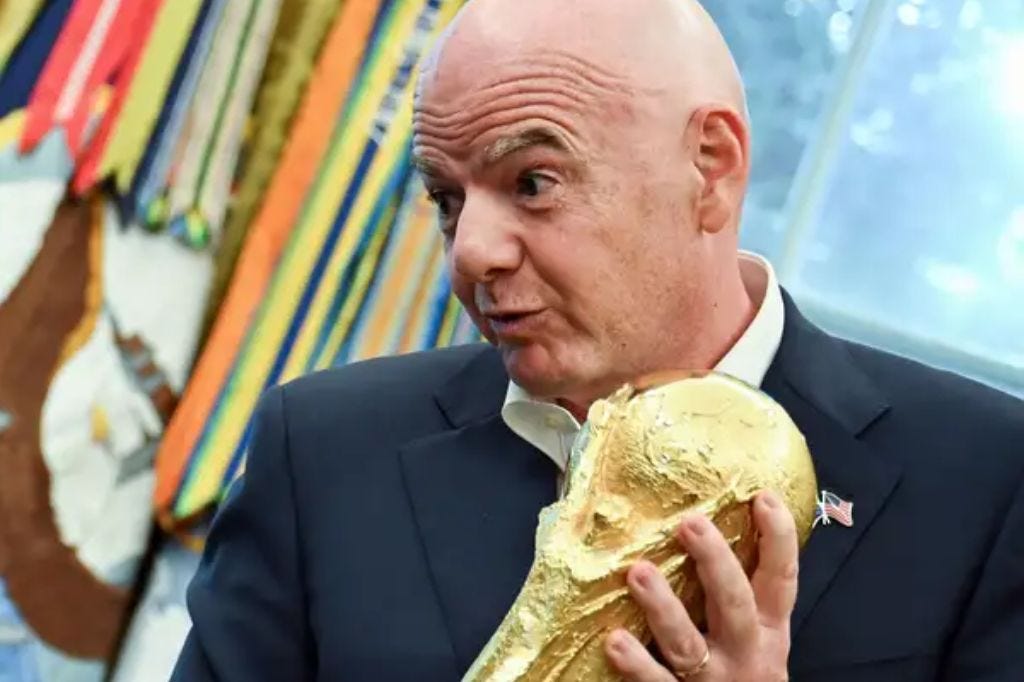
FIFA president Gianni Infantino has scrapped a contentious plan to sell stakes in the governing body’s competitions - including the men’s and women’s World Cups - to private investors, following widespread opposition from football’s major confederations and political leaders.
UEFA, which governs European football, said it welcomed the withdrawal of the proposal, describing it as “a victory for the whole game”, but also declared that it has lost confidence in Infantino’s leadership and accused him of failing to deliver on promises made during his 2016 presidential campaign.
Infantino announced on Saturday, that FIFA would no longer proceed with the proposal to create a new commercial subsidiary, FIFAForward Enterprise (FFE), and invite third parties to make minority, non-controlling investments in it. The plan had aimed to raise billions by selling up to around 20% of FFE to private investors, with US venture capital firm Thrive Eternalfounded by Joshua Kushner, brother of Jared Kushner - the son-in-law of US President Donald Trump - expected to lead the investor group.
UEFA had earlier voted to boycott World Cups and other FIFA competitions if the plan went ahead, and other confederations, including CONCACAF (North, Central America and the Caribbean) and the Asian Football Confederation (AFC), also voiced strong opposition.
UEFA’s damning statement
In a lengthy statement, UEFA said the current FIFA leadership has not only lost UEFA’s confidence but also that of many other members of the football family. When Infantino campaigned for the FIFA presidency in 2016, he promised transparency and that “the money of FIFA is your money… not the money of the FIFA president”. UEFA accused him of failing on both counts, calling the investment proposal a “shabby, back room, opaque deal” that was “anything but transparent”.
The body also said football cannot “keep going on” with “secret schemes of fast-track timescales cooked up by faceless individuals and of dubious benefit to the game”, and called for those responsible to be identified and held to account.
Why the plan collapsed
Infantino said the proposal had “created divisions” that were “no longer in the interest” of its original objective, and that it would not proceed.
Confederation opposition proved decisive. UEFA controls 55 votes, CONCACAF 35 and the AFC 46. If all members followed their confederations’ stance, that would have meant at least 136 of FIFA’s 211 member associations voting against it - well above the 106 needed to block it. Internal dissent also played a key role. FIFA’s chief operating officer, Kevin Lamour, said the administration had been “deceived” about the project and called it “the project of one person”. Carlos Cordeiro, Infantino’s senior adviser on global strategy and governance, resigned, calling the proposal “a bad deal for football” that would “mortgage football’s future”. UEFA’s pledge to pull all its national teams from FIFA competitions unless the plan was abandoned entirely made the political cost of pushing through the proposal untenable.
What the plan involved
The proposal, outlined in a 25-page document prepared with investment bank JP Morgan, included the creation of FFE to run FIFA’s main commercial events, including World Cups. It involved inviting third parties to buy minority, non-controlling stakes in FFE, with an eye to raising several billion dollars (reports cited figures around $4.2bn to over $10bn in total development funding).
An initial offer of $20m (£15m) was made to member associations that backed the plan, with a deadline of 19 September, and a potential $40m (£30m) per association if the full proposal passed. Projections suggested tournament payouts to member associations could rise to around €24m (£20.5m) per association in the 2035–2039 cycle. The document made no explicit mention of the women’s game, despite the plan covering both men’s and women’s competitions.
Fallout and what comes next
The episode has left Infantino under intense pressure ahead of his bid for a fourth term as FIFA president at the organisation’s 77th Congress in Morocco in March. Prior to this week, he had been expected to be re-elected unopposed, but the backlash has raised the possibility of rival candidates and a mass withdrawal of support from associations that had previously backed him.
In his statement, Infantino reiterated that his intent had been to “unite and improve” the game and to strengthen member associations “especially in countries where support is most needed”, but acknowledged that the proposal had clearly created division within FIFA itself. The proposal has now been abandoned; the next phase will be whether Infantino can repair relationships across the football family and restore confidence in his leadership before the March election.