


For decades, Scottish football’s connection with Italy existed largely in memory with Denis Law’s glamorous but difficult spell at Torino, Joe Jordan’s uncompromising years with Milan and Verona, and Graeme Souness helping Sampdoria to their first major trophy in the club’s history. Then came silence.
When Souness left Sampdoria in 1986, no Scottish player appeared in Italy for more than three decades. Serie A became a destination Scottish footballers admired from afar rather than one they could realistically see as part of their own career path. England remained the obvious route; Italy seemed distant, tactical, culturally unfamiliar and perhaps unforgiving. That idea has been dismantled with a new generation of Scottish footballers.
Scots are now woven into the fabric of Serie A in a way that would have seemed improbable only a few years ago. They are not simply passing through lower-table squads or collecting a handful of appearances. They are title winners, club captains, regular starters and, in Scott McTominay’s case, the league’s most celebrated individual player.
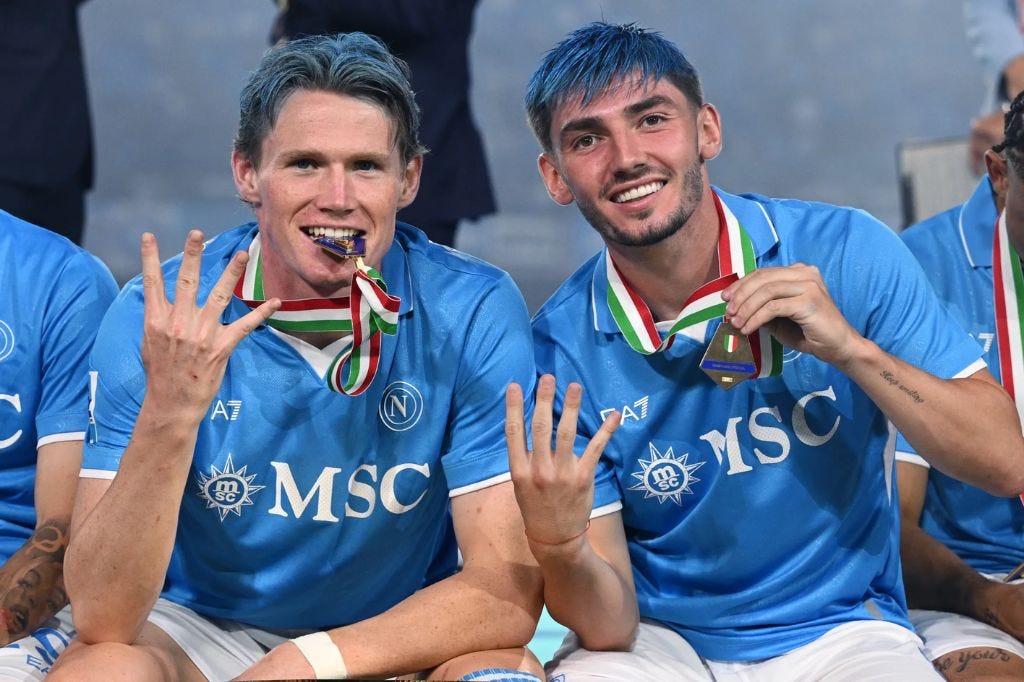
McTominay’s rise at Napoli has become the defining image of this new era. His Manchester United career was clouded by debate over his limitations, his position and his suitability for elite midfield football. In Naples, those questions have been replaced by adoration.
Under Antonio Conte, McTominay became a central figure in Napoli’s title-winning side. His 12 league goals, six assists and commanding physical presence helped drive the club to the Scudetto, while his influence earned him Serie A’s Player of the Year award.
The significance of that achievement extends beyond the numbers. Napoli is not a place where a player can hide. The city’s relationship with football is total and intensely personal. To be embraced there, as McTominay has been, means more than fitting into a system. It means becoming part of the story supporters tell about their club.
He has done exactly that. The “McFratm” nickname, murals and growing Scottish presence around the club are symbols of a bond that has formed quickly but feels genuine. McTominay has not been treated as an outsider enjoying an unexpected season abroad. He has been adopted as one of Napoli’s own.
Billy Gilmour’s arrival has strengthened the Scottish imprint at the champions. His role differs sharply from McTominay’s. Where McTominay attacks the box and imposes himself physically, Gilmour operates through control, technique and composure. Their partnership has offered a striking contrast to the old caricature of Scottish footballers in Italy - not merely willing runners or physical competitors, but players trusted to perform within one of Europe’s most tactically demanding and competitive environments.
The road to this moment began quietly with Liam Henderson. When Henderson left Celtic for Bari in 2018, he became the first Scot to play in Italy since Souness. It did not attract the fanfare that surrounds a move to England, and it was not designed as a shortcut to a bigger league. Instead, it became a commitment to an entirely different footballing life.
Henderson built a career across Bari, Verona, Empoli, Lecce, Palermo and Sampdoria, making Italy his professional home rather than a temporary destination. His long spell at Empoli, where he made more than a century of Serie A appearances, proved that a Scottish player could settle, develop and be valued over time in the Italian game.
His importance lies in what he made possible. Henderson showed younger Scottish players that Italy was not an impossible leap. It could offer opportunity, regular football and a tactical education unavailable in more familiar surroundings.
Aaron Hickey turned that possibility into a route others could follow. When Bologna signed Hickey from Hearts as an 18-year-old in 2020, they took a calculated risk on a player who had already gained first-team experience in Scotland. He responded by becoming one of Serie A’s most interesting young full-backs, combining comfort on the ball with the intelligence to operate in different roles across the back line.
His goal against Spezia in September 2021 carried particular significance. It made Hickey the first Scottish player to score in Serie A for 35 years. That goal was not simply a historical footnote. It marked the moment when the modern Scottish-Italian connection began to feel real.
Hickey’s development in Bologna also changed how Scottish footballers were viewed by Italian clubs. He arrived for a relatively modest fee and departed for Brentford in a deal reportedly worth around £17 million. His success underlined the value of a market that had been underestimated - players who had been exposed to senior football early, who were accustomed to competitive pressure, and who could develop without the financial risk attached to the big five European leagues.
Bologna then returned to Scotland for Lewis Ferguson, and his move has become one of the clearest examples of the relationship working at its best. Ferguson arrived from Aberdeen with a reputation for leadership, energy and goals from midfield. In Italy, those qualities have become more refined. He has developed into a key figure for Bologna, leading the side through historic domestic and European campaigns and eventually taking on the club captaincy.
His influence was especially evident as Bologna claimed the Coppa Italia, ending a 51-year wait for a major trophy. The club’s recent rise has been built around recruitment that identified players before their value became inflated, but Ferguson is more than a shrewd signing. He has become a leader in a side that has moved from survival mode to expectation.
There is a particular resonance in a Scottish midfielder captaining an Italian side. It represents a level of trust that goes beyond form or statistics. Italian football is deeply attuned to tactical detail, structure and responsibility. To be handed leadership within that environment is a powerful endorsement of Ferguson’s character and football intelligence.
Che Adams has added another dimension to the Scottish presence. Torino have found in him a striker capable of offering physicality, movement and a direct threat in the penalty area. His early goals gave the Granata a sharper edge, while his style has suited a league in which forwards must often function as a focal point as much as a finisher.
Josh Doig’s career tells a different but equally important story. He moved from Hibernian to Hellas Verona as a teenager, choosing development in Italy rather than the more conventional route to England. His progress as a left-back has been built on work rate, athleticism and the ability to adapt to the positional demands of Italian football.
Doig’s move to Sassuolo in 2024 has allowed him to continue that development in Serie A, and his growing experience in the division suggests that the pathway now extends beyond high-profile midfielders or established internationals. Scottish full-backs, defenders and young prospects now see Italy as a viable place to build a career rather than merely revive one.
The next generation is already arriving. Lennon Miller’s move to Udinese in 2025 represented another significant step. He entered Italy with high expectations after emerging as one of Scotland’s most promising young midfielders, but Serie A will ask different questions of him. It will demand patience, tactical awareness and the capacity to develop without the assumption that talent alone is enough.
Kieron Bowie’s journey, from joining Verona before moving to Sassuolo, further illustrates the changing recruitment landscape. Italian clubs are no longer waiting for Scottish players to prove themselves in England before taking interest. They are watching Scottish Football directly, identifying prospects earlier and offering a developmental route that can be as valuable as any move south of the border.
Jack Hendry’s loan spell at Cremonese was brief, with four Serie A appearances in 2023, but it was another indication of the widening connection. Scotland’s relationship with Italy is no longer built around a single club, position or profile. There is now a genuine spread of players across the league, from title challengers to developing sides and from established internationals to emerging talent.
The appeal is clear on both sides. For Italian clubs, Scotland offers players shaped by first-team football, competitive intensity and an environment where results matter early. The best prospects often arrive with more senior experience than similarly aged players elsewhere in Europe, and at fees that remain relatively accessible compared with the inflated English market.
For Scottish players, Italy provides a different kind of development. Serie A demands positional discipline, sharper decision-making and greater understanding of the game without the ball. The league can expose weaknesses, but it can also add layers to a player’s game that are difficult to acquire in more frantic, transition-heavy competitions.
That exchange has created a relationship that feels increasingly self-sustaining. Henderson established the route. Hickey gave it commercial credibility. Ferguson turned it into a leadership story. McTominay transformed it into a triumph at the highest level.
The history still matters. Law’s bold move to Torino in 1961 made him one of the earliest Scottish stars to test himself in Italy, even if his time there was short. Jordan brought his formidable style to Milan and Verona. Souness became a key player in Sampdoria’s rise, winning the Coppa Italia and proving that a Scottish midfielder could excel in an elite Italian setting. But the modern Scottish presence has moved beyond nostalgia.
Scotland’s players are no longer travelling to Italy to add an interesting chapter to their careers. They are choosing Serie A because it offers a platform to improve, compete and matter. The league, in turn, has discovered that Scottish football contains more than physicality and fighting spirit. It contains technical quality, leadership, tactical adaptability and players capable of shaping the biggest moments.
This is no longer an Italian adventure for Scottish footballers. It is becoming a proper footballing corridor, one that will define the next generation of Scotland players as profoundly as the old journey to England once did.