


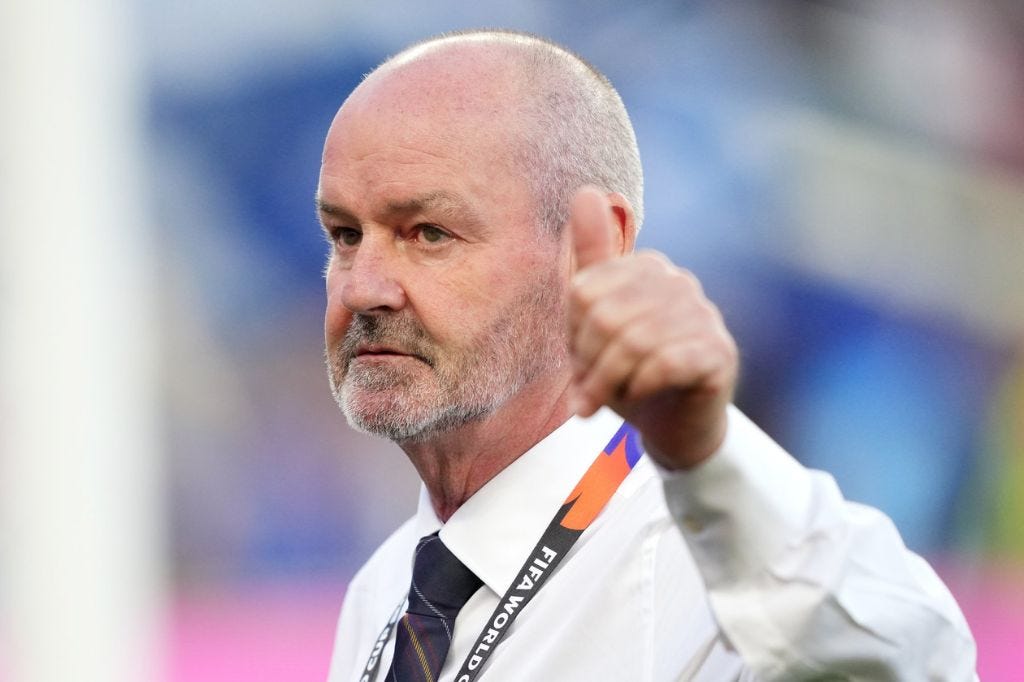
There is a peculiar kind of fear that grips Scottish football whenever even a flicker of success appears on the horizon. It is not the fear of failure, that is baked into the national psyche at this point, but the fear of losing whatever fragile progress has been made. And so, instead of building on it, questioning it, or daring to improve it, the instinct is to preserve it at all costs. That instinct is precisely what led the Scottish FA to hand Steve Clarke a new four-year contract prior to the 2026 World Cup. It is also precisely why Scotland, once again, risks going absolutely nowhere.
Let’s deal with the central myth first, that Steve Clarke has earned a long-term deal because he got Scotland to three major tournaments. On the surface, it sounds like an unanswerable defence. Three tournaments. After decades in the wilderness. A nation restored. Job done. Except it isn’t.
Qualification is not the same as progression. Participation is not the same as performance. And turning up is not the same as competing.
Clarke has undeniably overseen a period where Scotland have made it back onto the international stage. That matters. It should be acknowledged. But it should not be weaponised to shut down any serious analysis of what actually happens when Scotland get there. Because when you strip away the emotional relief of simply qualifying, what remains is a body of work that is deeply underwhelming, tactically limited, and ultimately self-defeating.
The Euro 2020, which was delayed due to COVID, Scotland were desperate, a moment built up over more than two decades since we last qualified for a major tournament. Scotland scored one goal. One. They finished bottom of their group. There were glimpses of fight, yes, but tactically it was reactive, cautious, and predictable.
It was more of the same four years later at Euro 2024, only worse. Two points. No wins. A team that looked shackled rather than inspired. A side that entered games seemingly more concerned with not losing heavily than with actually trying to win. The patterns were familiar, deep defensive lines, an over-reliance on structure, and a complete absence of attacking ambition until it was too late.
And now, with the 2026 World Cup, we were asked to believe that it would be different. That somehow, without any meaningful shift in approach, Scotland would suddenly evolve into a team capable of doing more than just making up the numbers.
There was no evidence to support that belief and the performances and results against Haiti and Morocco proved just that. Because Steve Clarke’s Scotland is, at its core, still Steve Clarke’s Kilmarnock, only with better players. That is not a compliment.
At Kilmarnock, Clarke’s pragmatism made sense. He built a team that was difficult to beat, disciplined, and structured. It was effective within that context. But international football, particularly tournament football, demands something more. It demands adaptability. It demands courage. It demands the willingness to take calculated risks when the moment requires it. Clarke does not do risk.
His tactical blueprint has barely shifted. A back five that becomes a back three that becomes a back five again depending on how much pressure Scotland are under. Wing-backs who spend more time pinned back than pushing forward. A midfield tasked primarily with containment rather than creativity. And an attack that often feels isolated, starved of service, and expected to conjure something out of nothing. It is safety-first football taken to its logical extreme. And the logical extreme is stagnation.
The most frustrating aspect is that this Scotland squad is not devoid of talent. Far from it. There is quality in midfield, energy in wide areas, and enough attacking options to at least attempt a more progressive style. But time and again, those players are asked to operate within a system that prioritises caution over expression.
And then there is the issue of selection, where Clarke’s conservatism morphs into something even more baffling. International football always involves compromise. Managers have to balance form, fitness, experience, and tactical fit. But Clarke’s selections too often lean on loyalty to the point of absurdity. Players who are barely featuring at club level continue to receive call-ups, while those in form are left watching games at home. It sends a message and not a good one.
It tells players that performances at club level are not the primary currency. That once you are “trusted,” your place is secure regardless of what you are doing week in, week out. It removes competitive tension from the squad. It dulls the edge. And then we arrive at the most indefensible decision of all, the inclusion of what can only be described as a developmental passenger in a tournament squad.
Calling up a young player not on merit, not on form, but on the basis of potential, who his Daddy is, and future allegiance is one thing in a friendly or a qualification campaign. But taking up a place at a World Cup? That crosses a line. Tournament squads are finite. Every place matters. Every inclusion should strengthen the team in the here and now. This is not a training camp. It is not a long-term investment portfolio. It is the pinnacle of the sport.
To use one of those precious spots on a player who is not expected to contribute on the pitch is, frankly, insulting to those who have earned it through consistent performances at club level. It reeks of small-time thinking of a manager more concerned with securing future loyalty than maximising present potential. And that, ultimately, is the thread that runs through Clarke’s tenure, a persistent underestimation of what Scotland could be.
The rhetoric often mirrors the tactics. Measured. Cautious. Grounded to the point of pessimism. There is a fine line between realism and defeatism, and Clarke has spent much of his time hovering uncomfortably close to the latter.
Listen to the messaging around tournaments. The emphasis is rarely on what Scotland can do, but on what they must avoid. Not getting embarrassed. Staying competitive. Keeping games tight. It is the language of damage limitation, not ambition. And that mindset seeps into everything.
It seeps into how the team starts games - tentatively, cautiously, almost waiting for something to happen rather than making it happen. It seeps into how they react when they go behind - often too slow to change, too reluctant to deviate from the plan. And it seeps into how supporters experience tournaments, not with excitement, but with a familiar sense of impending frustration.
Which brings us to the Tartan Army. If there has been one undeniable success story of Scotland’s recent tournament appearances, it has been the supporters. They have travelled in numbers, in voice, and in spirit. They have turned cities into celebrations. They have created an atmosphere that is the envy of other nations.
At this World Cup, the narrative has once again centred on them, on the scenes in Boston, on the drinking, on the camaraderie, on the spectacle of Scottish support exported abroad. And while that is something to be proud of, it is also something of a distraction.
Because it raises an uncomfortable question, is the story of Scotland at major tournaments now more about the fans than the football? When the most memorable moments are happening off the pitch, something is wrong. The feel-good factor that Clarke is often credited with restoring does not survive contact with the actual football. It dissipates. It drains away through sterile performances and predictable outcomes. The noise in the stands is not matched by the ambition on the pitch. And yet, despite all of this, there remains a reluctance in some quarters to critically assess Clarke’s position.
To question him is, apparently, to risk unravelling the progress made. To demand more is to be ungrateful. To point out the obvious shortcomings is to ignore the context of where Scotland were. That argument no longer holds.
Progress is not a destination. It is a process. And if that process stalls or worse, regresses then it must be addressed. The idea that Clarke is beyond reproach because he ended the qualification drought is not just flawed; it is dangerous. It lowers the bar.
It suggests that simply being present is enough. That Scotland’s ceiling is participation. That anything beyond that is a bonus rather than an expectation. And that is where the “greatest ever manager” narrative tips from generous into absurd. Scotland has a footballing history that deserves more respect than that. To elevate Clarke to that status on the basis of qualification alone is to ignore the broader context of what international management should entail.
Great managers do not just get teams to tournaments. They make an impact when they get there. They adapt. They evolve. They find ways to maximise what they have. Clarke has shown little inclination to do any of those things.
The decision to hand him a four-year contract extension looks, in that light, less like a reward for success and more like an act of institutional caution. A move designed to avoid uncertainty rather than embrace opportunity. A signal that the Scottish FA is content with the current trajectory, even if that trajectory leads to the same disappointing destination.
There was, after Euro 2024, a natural juncture for reflection. A moment to ask difficult questions. To assess whether the approach that got Scotland to tournaments was also capable of taking them beyond the group stages. Instead, the answer was to double down prior to this World Cup. To secure Clarke’s future not because he had demonstrated the ability to evolve, but because there was a fear he might leave. As if continuity, in and of itself, is inherently valuable regardless of what is being continued.
And so Scotland are heading into their final group game of this World Cup following a familiar script. If they somehow manage to get out of the group for the first time in their history, it will be hailed as a breakthrough. A vindication. Proof that patience has paid off. But even that achievement would need to be interrogated.
Because in tournament football, context matters. Results do not exist in a vacuum. A favourable draw, underperforming opponents, moments of fortune, all of these can shape outcomes. The question is not just what Scotland achieve, but how they achieve it.
Will it be the result of a team imposing itself, taking initiative, and embracing the challenge? Or will it be a case of surviving, scraping through, and relying on others to falter? Based on everything we have seen so far, the latter feels far more likely. And that is the crux of the issue.
Steve Clarke has made Scotland harder to beat. He has restored a degree of structure and organisation. He has ended the long wait for tournament football. But he has also imposed a ceiling.
A ceiling defined by caution. By predictability. By an unwillingness to take the kind of risks that might, occasionally, lead to failure but might also lead to something more.
Scotland deserves a manager who is prepared to push beyond that ceiling. Who sees qualification not as the end goal, but as the starting point. Who trusts players to play, rather than instructing them primarily not to lose. Until that shift happens, the cycle will continue.
Qualify. Celebrate. Compete cautiously. Exit quietly. Repeat.
And no amount of contract extensions, narrative management, or historical revisionism will change that. Because at some point, simply being there has to stop being enough.