


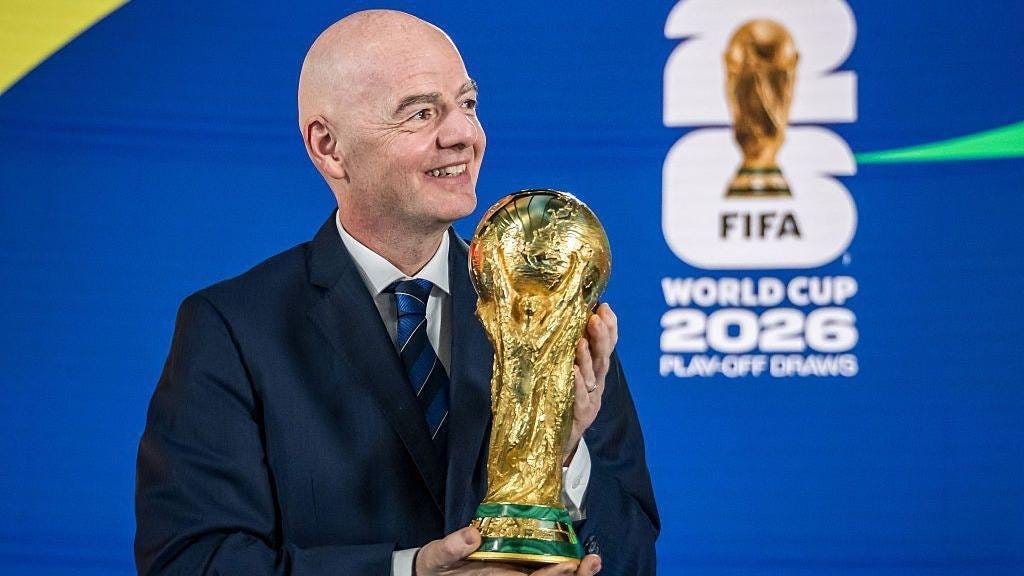
The world’s most popular sport is facing its most serious governance crisis in a generation. In an unprecedented move, UEFA – the body that runs European football – has declared that none of its 55 national teams will take part in any FIFA competition, including the men’s and women’s World Cups, so long as president Gianni Infantino presses ahead with plans to sell ownership stakes in those tournaments to private investors. The statement, issued after an emergency virtual summit of every European association, is blistering in tone and absolute in its threat: “The World Cup is not for sale.”
The Scottish FA has publicly backed UEFA’s stance, but the practical ramifications are stark - if the boycott holds, Scotland’s next realistic path to a men’s World Cup could be blocked not by opponents on the pitch, but by a boardroom battle in Zurich. And for Infantino and FIFA itself, the revolt signals something more dangerous than bad headlines, a credible challenge to the very legitimacy of its authority over the global game.
FIFA’s “Forward Enterprise” plan
At the heart of the dispute is what FIFA calls its “Forward Enterprise” proposal - a plan to create a new company that would hold and manage the commercial and operational rights to FIFA’s major competitions, including the World Cup, and to sell minority ownership stakes in that vehicle to private investors. According to reports, the move could raise up to $20bn, with the stated aim of redistributing more money to member associations and funding development projects around the world.
UEFA and its allies see this very differently. In their view, the proposal effectively turns the World Cup into an “investment product”, subjecting the sport’s most sacred tournament to the logic of shareholder dividends rather than the interests of players, fans and national associations. The European football body has accused Infantino and FIFA of conceiving the plan in secret, then pushing it to the brink of approval without “meaningful consultation” with those entrusted with stewarding the game. The language is deliberately moral as well as legal - “No one has the moral authority to sell what they merely hold in trust for the next generation,” the statement reads.
FIFA insists it would retain sole control and that any investment would be structured to protect the integrity of its competitions. But for UEFA, the principle is non-negotiable: “The moment external investors acquire ownership interests in FIFA competitions, football changes forever. Commercial return becomes a permanent obligation… every decision… is no longer driven by what best serves the game, but by what best serves shareholders.”
Why Europe can make or break the World Cup
The threat of a boycott is not mere rhetoric; it is a calculated exercise in leverage. European nations dominate the modern World Cup in sporting, commercial and cultural terms. They supply many of the tournament’s biggest stars, its most valuable broadcast markets and its most lucrative sponsorship partnerships. A World Cup without Germany, France, World Cup winners Spain, England is not just a diminished tournament; it is, in commercial terms, a fundamentally different product.
UEFA knows this. Its statement makes clear that the boycott is intended to deny the sell-off plan any legitimacy: “Europe’s position is clear. We will never lend this model our legitimacy.” By refusing to participate, European associations hope to make the investment proposition unviable - why would private capital buy into a World Cup franchise if the most valuable teams simply do not show up?
The first concrete test could come sooner than the next men’s World Cup. The boycott applies to any FIFA competition, including youth and women’s tournaments. Reports suggest the 2027 Women’s World Cup could be the first major event affected if the dispute is not resolved. For a sport that has worked hard to build momentum around the women’s game, that prospect is explosive in its own right.
Scotland’s place in the storm
For the Scotland national team, the implications are both symbolic and practical. On the surface, the SFA’s position is clear, it stands “fully supportive” of UEFA’s decision, with president Mike Mulraney and chief executive Ian Maxwell representing the association at the emergency summit. In a separate statement, the SFA reiterated its opposition to any model that would “mortgage [football’s] future for financial gain” and subjugate the interests of associations, leagues, clubs, players and supporters to investor returns.
There is a pragmatic dimension to Scotland’s alignment with UEFA. Scotland benefits significantly from UEFA’s distribution model, which channels Champions League and European Championship revenues back into the domestic game via the SFA and its clubs. A FIFA structure that privileges private investors and global commercial partners could, in time, dilute that flow or reorient it towards different priorities.
But the boycott also carries real risk for the national team’s competitive future. If UEFA’s threat is carried through, Scotland would be barred from qualifying for – and participating in – future World Cups, regardless of performance on the pitch. For a country that endured nearly three decades of heartbreak and near-misses before reaching this summer’s World Cup, the idea that the next chance to reach a men’s World Cup might be nullified by a governance dispute is bitter indeed.
There is also a domestic dimension. Scottish club football is already financially fragile compared to its English counterpart. Any long-term fracture between UEFA and FIFA risks destabilising the calendar, confusing sponsors and unsettling broadcasters all of which ultimately feed into the revenues that keep many clubs afloat. The SFA’s statement acknowledges this, warning that “the interests of national associations, leagues, clubs, players and supporters” cannot become “subordinate to investor returns”. Yet the very act of supporting a boycott increases the likelihood of precisely that kind of disruption.
In public, Scottish officials are framing their stance as a defence of football’s soul. Behind closed doors, they will be acutely aware that if the boycott threat fails – if enough other confederations back Infantino and the investment goes ahead regardless – Scotland could find itself isolated, having burned bridges in Zurich while the new model proceeds anyway.
What the boycott means for Infantino
For Gianni Infantino, UEFA’s revolt is the most serious challenge to his authority since he became FIFA president. He has long portrayed himself as a globalist visionary, expanding the World Cup, cultivating relationships with political leaders and positioning FIFA as the undisputed custodian of world football. The Forward Enterprise plan fits that narrative - a bold, financially ambitious move designed to cement FIFA’s dominance [and his own legacy] and fund its global development agenda.
UEFA’s boycott threat punctures that narrative in two ways. First, it exposes the limits of Infantino’s power. Despite controlling 211 member associations, FIFA’s legitimacy rests on the participation of the strongest footballing nations. If Europe walks away, the World Cup ceases to be the truly global tournament Infantino claims to protect. Second, it reframes the debate from “modernisation and development” to “governance by intimidation”. UEFA’s accusation that FIFA is presenting associations with an ultimatum – accept the “irreversible capture” of football’s greatest competitions or bear the consequences – casts Infantino not as a reformer but as a despot.
The timing is also damaging. The past few months have already seen tensions flare over scheduling changes, political entanglements and disciplinary decisions that UEFA has described as “unprecedented, incomprehensible and unjustifiable”. UEFA president Aleksander Čeferin’s decision to boycott this summer’s World Cup final only underscored the depth of the rift. The current crisis is not an isolated dispute; it is the culmination of years of friction over who truly controls the game.
Infantino now faces a series of choices. He can press ahead, call the vote among FIFA’s 211 members and hope that enough associations outside Europe – lured by promises of increased funding – will back the plan regardless of UEFA’s opposition. That would technically “win” the vote but risk a lasting schism, with European teams absent from FIFA’s flagship events and a parallel ecosystem of tournaments potentially emerging under UEFA’s own banner.
Alternatively, he can retreat, at least temporarily. He could pause the Forward Enterprise proposal, commission further “consultation” and attempt to rebuild trust with UEFA and the European leagues, who have issued their own strongly worded statement condemning the plan as a threat to the stability of domestic football. That would be a humiliation in the short term but might preserve FIFA’s unity and long-term authority.
A third option is to try to split Europe. Already, some voices within the continent – such as the Czech FA president – have expressed support for Infantino’s plan, suggesting that not all 55 UEFA members are equally committed to the boycott line. If cracks appear, FIFA could argue that UEFA’s position is not as monolithic as its statement claims. But given the unanimity of the public declaration and the intensity of feeling in key associations, that looks like a high-risk strategy.
The broader ramifications for world football
Beyond the immediate standoff, the crisis raises profound questions about the future structure of global football. For decades, the model has been relatively stable - FIFA governs the World Cup and the international calendar; the confederations run their own continental competitions; clubs and leagues operate under national associations, with UEFA gradually accruing more power and revenue in Europe. The Forward Enterprise plan, as UEFA sees it, disrupts that balance by inserting private capital directly into the ownership of FIFA’s competitions, thereby shifting incentives towards commercial maximisation rather than sporting governance.
If the boycott succeeds and the plan is abandoned, FIFA’s and more importantly Infantino’s authority will be curtailed, with UEFA emerging as the de facto senior partner in any future negotiations over the international calendar and tournament formats. That could lead to a more Europe-centric global game, with other confederations forced to align with European priorities if they want access to UEFA’s markets and clubs.
If the boycott fails and the investment goes ahead, the precedent is troubling - the World Cup, and potentially other FIFA tournaments, would become partly owned assets, answerable in part to investors whose primary duty is financial return. That could accelerate the trend towards ever-more crowded calendars, more tournaments and more “products”, with player welfare and domestic league integrity increasingly treated as secondary concerns – exactly the outcome European leagues warn against.
There is also the risk of fragmentation. UEFA has already explored the idea of alternative competitions and has the financial muscle to sustain a rival ecosystem if necessary. A world in which Europe runs its own elite international tournaments outside the FIFA umbrella is no longer science fiction; it is a credible contingency plan. That would be a profound blow to the idea of a single, unified world championship.
What happens next?
The immediate timeline is tight. FIFA’s member associations are due to vote on the Forward Enterprise proposal in September. Between now and then, both sides will be lobbying furiously, seeking to shore up support and test the resolve of the other. UEFA’s unity will be scrutinised; FIFA’s ability to deliver a credible investment package without Europe will be stress-tested by potential partners.
For Scotland, the coming weeks will require careful navigation. Publicly, the SFA will continue to echo UEFA’s language of principle and protection. Privately, it will be modelling scenarios - what happens to the international calendar if the boycott bites? How are World Cup qualifiers affected? What are the financial implications for the SFA and for Scottish clubs if the dispute drags on?
For fans, the message is both simple and unsettling. The next time Scotland lines up in a World Cup qualifier, it may not just be fighting for a place at the tournament; it may be fighting for the right to be allowed to compete at all.
A game at a crossroads
Football has always been more than a business. Its power lies in the sense that it belongs to everyone – to the child kicking a ball in a park, to the local club run by volunteers, to the national team that carries a country’s hopes. That is the core of UEFA’s argument: “The FIFA World Cup belongs to football. It always will. And so long as Europe has a voice, it will never be for sale.”
But the forces arrayed against that vision are formidable. The sums of money now involved in elite football are such that the idea of keeping the World Cup “pure” from commercial pressures is increasingly difficult to sustain. Infantino’s plan, however flawed, is a response to that reality - a bet that controlled privatisation can fund the global game without destroying its soul.
UEFA’s boycott is a wager on the opposite - that the threat of losing Europe is enough to force FIFA back from the brink and reaffirm that football’s highest levels remain governed by associations, not investors. For Scotland, caught between principle and participation, the outcome will shape not just the next World Cup cycle but the very nature of international football for decades to come.
Whatever happens, one thing is clear the game is at a crossroads. The choices made in Zurich, Nyon and Hampden over the coming months will determine whether the World Cup remains a tournament owned in spirit by the global football community – or becomes, in part, an asset owned by those who see it primarily as a vehicle for profit.